Author: Vicki Cutler

PFKG publishes new knowledge shares to address persistent confusion in passive fire specification

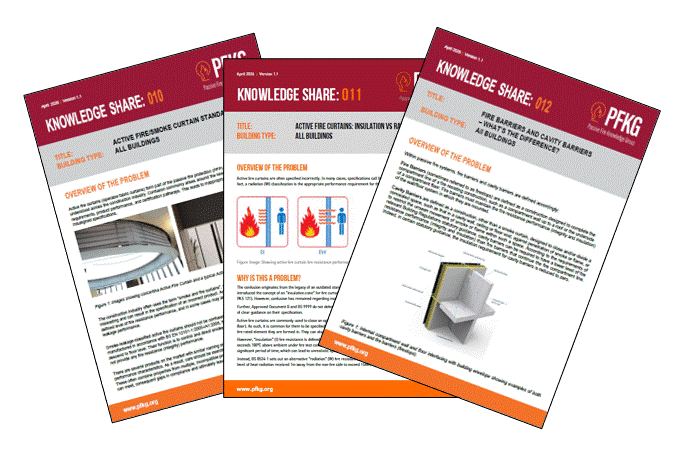
The Passive Fire Knowledge Group (PFKG) has published three new Knowledge Shares to help address some of the most common misunderstandings in passive fire protection.

The new Knowledge Shares are:

🔹 KS10 – Active fire/smoke curtain standards

🔹 KS11 – Active fire curtains: insulation vs radiation

🔹 KS12 – Fire barriers and cavity barriers – what’s the difference?

These are free to download now via the resources section of the PFKG website: https://pfkg.org/reports-2/

𝐋𝐚𝐭𝐞𝐬𝐭 𝐚𝐧𝐧𝐮𝐚𝐥 𝐰𝐨𝐫𝐤-𝐫𝐞𝐥𝐚𝐭𝐞𝐝 𝐟𝐚𝐭𝐚𝐥𝐢𝐭𝐢𝐞𝐬 𝐩𝐮𝐛𝐥𝐢𝐬𝐡𝐞𝐝

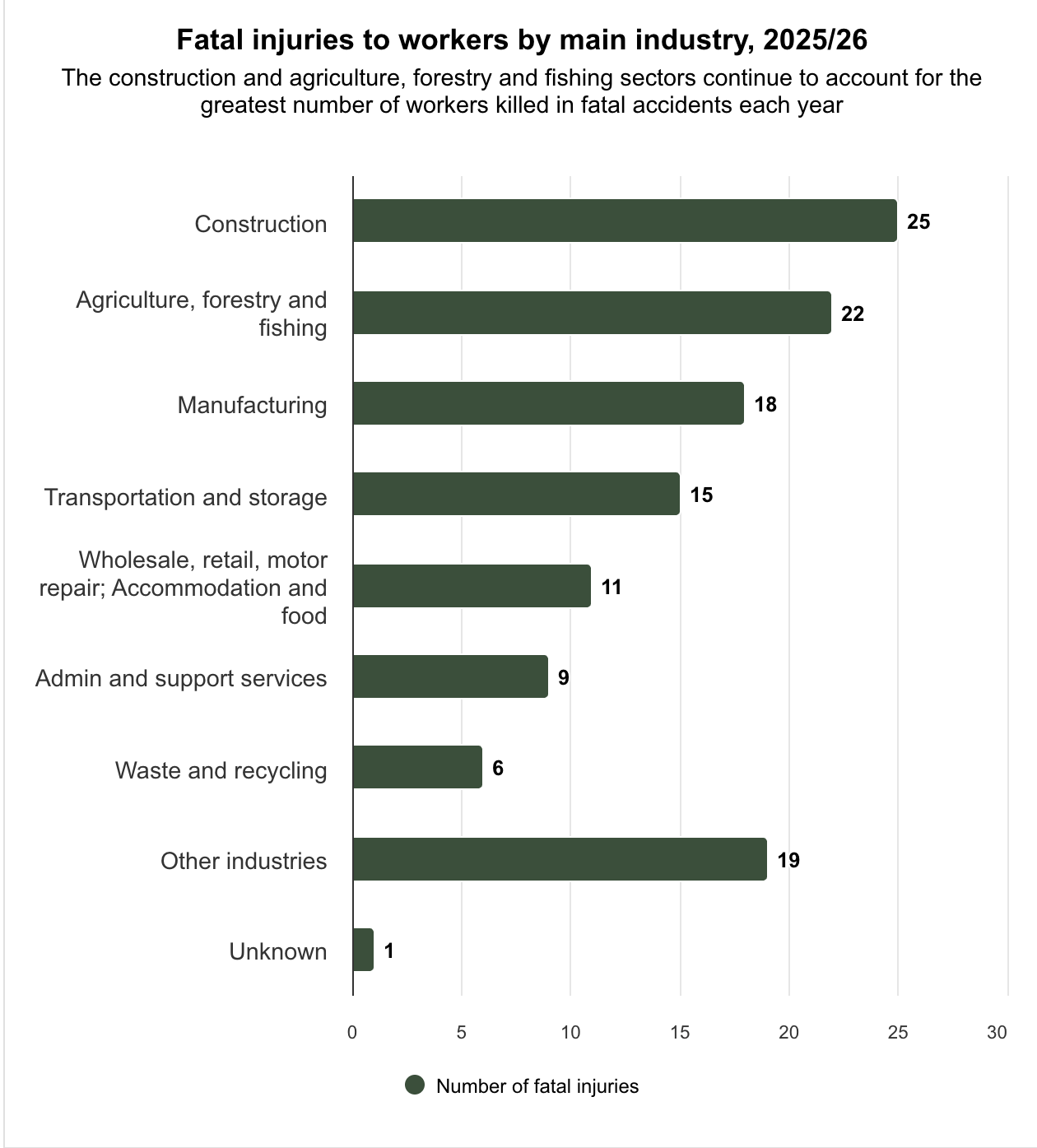
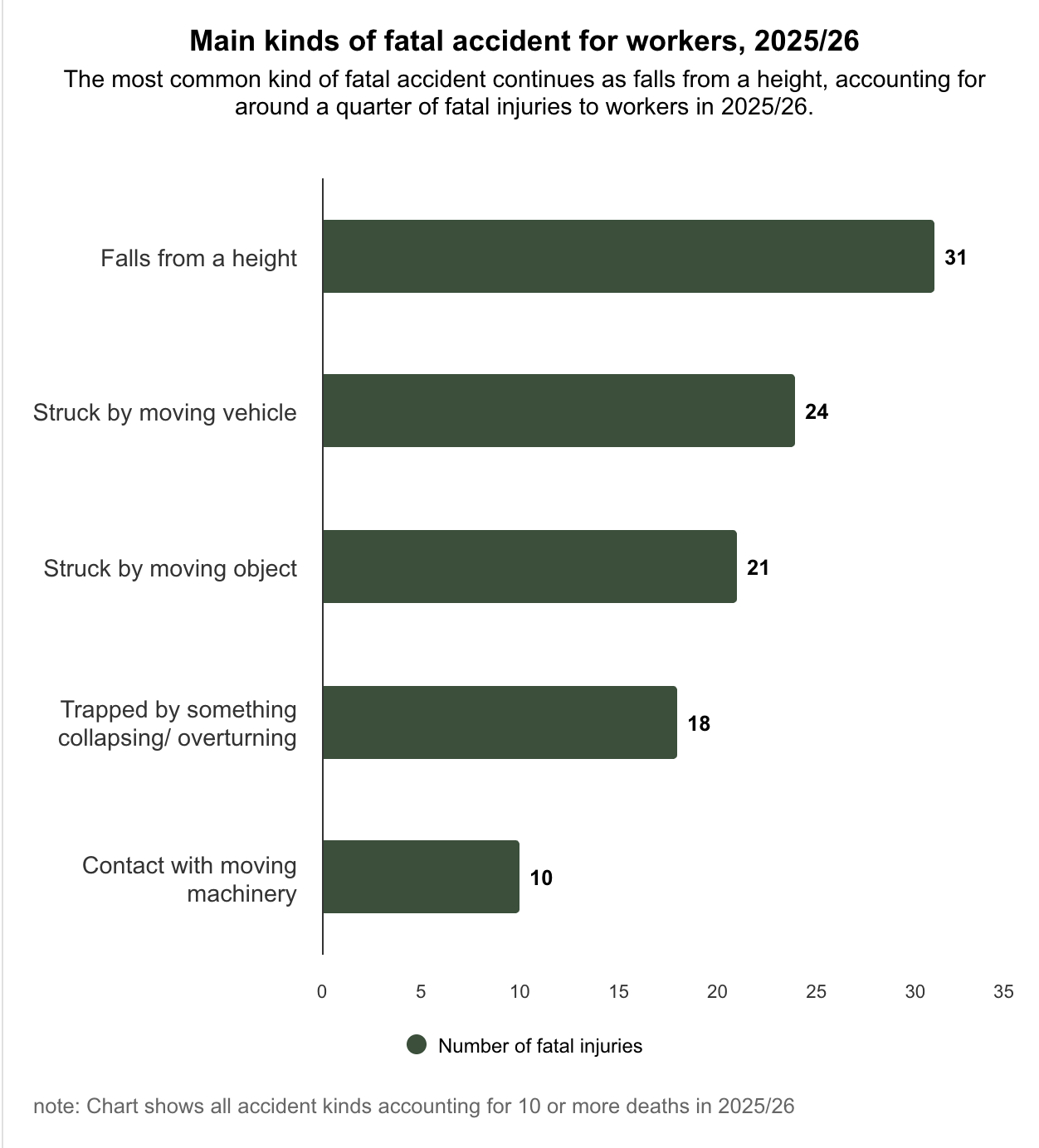
🔹 126 workers killed in work-related accidents in 2025/26 (RIDDOR)

🔹 The industries with the highest number of deaths continue to be construction (25) and agriculture, forestry and fishing (22). Of all main industry sectors, agriculture, forestry and fishing continues to have the highest rate of fatal injury per 100,000  workers (8.09) followed by waste and recycling (5.47). This compares to an average 0.37 fatal injuries per 100,000 workers across all industries combined.

🔹 The most common cause of fatal injuries continues to be falls from a height (31), representing around a quarter of worker deaths in 2025/26.

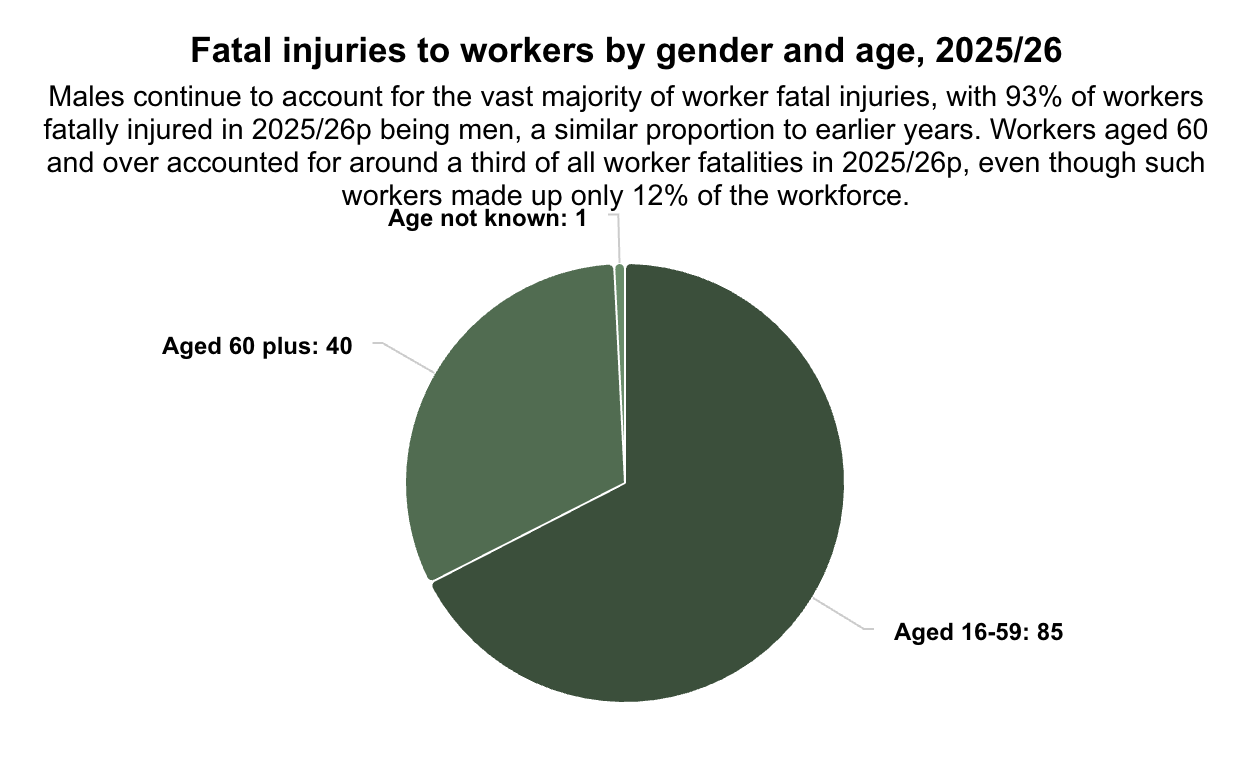
🔹 Workers aged 60 and over accounted for around a third of all fatalities during the year (40) despite that age group accounting for just 12 per cent of the workforce.

🔹 A further 104 people who were not at work were killed as a result of work-related incidents in 2025/26. This refers to members of the public who were not directly working themselves at the time of the incident.

You can read the full report here

Understanding mesothelioma risk in the trades

Men working in skilled trades experience higher rates of mesothelioma mortality than the wider population.

Asbestos was widely used in UK construction until it was banned in 1999. As a result, it can still be present in buildings constructed or refurbished before 2000, and routine maintenance, repair or renovation work may disturb it.

Trades with higher potential exposure include:

  • electrical engineering
  • carpentry and joinery
  • plumbing
  • heating and ventilation
  • flooring and wall tiling

Mesothelioma is a cancer caused almost exclusively by exposure to asbestos. It most commonly affects the lining of the lungs, but can also affect the lining of the abdomen.

Symptoms may include:

  • chest pain or shortness of breath
  • a persistent cough, difficulty swallowing or a hoarse voice
  • fatigue, a high temperature or heavy night sweats
  • unexplained weight loss or loss of appetite
  • curved nails over rounded fingertips (clubbing)

These symptoms can develop many years after exposure to asbestos. If you or someone you know working in the trades is experiencing any of these symptoms, encourage them to speak to their GP.

HSE campaigns provide free guidance and resources, including:

Fire Fatalities beyond the dwelling of fire origin in Scotland

The Building Standards Division (BSD) of Scottish Government requested that the Building Research Establishment (BRE) scrutinise data, which is held by the Scottish Fire and Rescue Service (SFRS), in order to determine specific fire death events and any correlations relating to external cladding (the data that the SFRS holds comes from its own Incident Recording System).

This report, published in March 2026, builds on a first phase of work which was reported on 09 June 2023 (Fire fatalities beyond the dwelling of fire origin in Scotland - Draft Interim Report).

The study reports on fire fatalities which have occurred in Scotland where the victim has died beyond the dwelling of fire origin. This specifically includes multi storey flats and tenements and whether external wall cladding was recorded as being involved during the fatal fire event.

The study is focused on 75 reports covering 81 fire fatalities. The key findings from the second phase of work are shown below:

  • In 80% of these (65 fire fatalities) the room of fire origin was determined to be -the bedroom, kitchen or living room.
  • Most fatalities occurred in the bedroom (42%).
  • There was only one case of a fire fatality occurring beyond the flat of fire origin; the death resulted from smoke inhalation. The SFRS investigation, concluded that, in their professional opinion, had the occupant been in, and / or remained within their own flat for the entire duration of the fire event and followed SFRS advice to open windows and to ‘stay put’’, this individual would likely not have died. The SFRS personnel further reported that there was no failure of the compartmentation – BRE Global noted the floor of the flat did collapse to the flat below at a later stage of the fire.
  • No mention was made by the SFRS, in any of the 75 FI reports, that cladding had either:
  1. a) been involved in any of these fires, or
  2. b) contributed to the spread of fire beyond the flat of fire origin, or
  3. c) contributed to the single fire fatality, beyond the flat of fire origin.

The full report and information contained within, can be found on the Scottish Government website here.

Major revision of fire door standard published

BSI has released BS 8214:2026 Fire-resisting and smoke control doors – Practical considerations concerning specification, design and performance in use – Code of practice.

The new standard, published on 20 March 2026, replaces BS 8214:2016, which has now been withdrawn and represents a substantial update to the long-standing fire door standard, marking “an important step forward in fire door guidance.”

Unlike its predecessor, which focused predominantly on timber-based assemblies, the revised document expands its remit significantly. It now “covers fire doors as a coordinated complete system however they are supplied to site, whether this is as door assemblies, doorsets or door kits.” Crucially, it no longer limits itself to timber constructions but instead “covers fire doors of many materials, including timber, steel, glazed metal, and composite designs.

This broadening of scope reflects the diversity of fire door solutions now used across the UK’s construction and refurbishment sectors. According to the revised guidance, BS 8214:2026 provides recommendations for “pedestrian fire-resisting and smoke control doors of all types and materials – including timber, metal, aluminium, and composite doors.”

A key development in the 2026 edition is its extension into areas previously lacking structured industry guidance. As the document notes, it “addresses the lack of a code of practice for metal and composite fire doors, providing new guidance for installation, maintenance and manufacture.”

BS 8214:2026 introduces clearer explanations of door classifications and performance evidence, supported by technical updates across several key areas. Notably, Section 9.4 has been strengthened to “prevent misinterpretation and non-compliant installations,” addressing a recurring industry concern.

Other updates include “improved guidance on sealing the interface between fire door frames and the surrounding structure,” with detailed recommendations on acceptable materials such as stone wool, mastic, and foam sealants.

BSI emphasises that fire doors remain critical to life safety, noting they “work in combination with other construction elements to protect escape routes and control fire and smoke spread.” The revised standard seeks to ensure they are “specified, installed, and maintained according to best practice, reducing risk and increasing trust.”

What's changed?

BS 8214:2026 supersedes BS 8214:2016 and introduces several important changes:

Expands coverage from timber doors to include fire door assemblies of all materials (timber, steel, aluminium, composite), with annexes for material-specific guidance.

Addresses the lack of a code of practice for metal and composite fire doors, providing new guidance for installation, maintenance and manufacture.

Clarifies installation requirements, especially section 9.4, to prevent misinterpretation and non-compliant installations.

Updates smoke control guidance to align with revisions in BS 9991, including best practice for sealing under-door gaps.

Incorporates changes required by post-Brexit legislation (UKCA and CE marking) and new regulatory requirements from the Building Safety Act, Fire Safety Act and related legislation.

Responds to feedback from industry associations, certification bodies and regulatory authorities.

More information about the Standard can be found on the BSI website here.

Revision to emergency lighting standard released

The British Standards Institute (BSI) has updated its code of practice for the emergency lighting of premises, setting out clear recommendations and guidance on the design, installation, wiring, and maintenance of emergency lighting systems

Superseding the 2016 version, the revised standard – BS 5266-1:2025 Emergency lighting. Code of practice for the emergency lighting of premises – aims to promote a consistent approach to emergency lighting and ensure people can safely exit or remain in a building during emergencies, while also supporting the use of essential safety equipment.

BSI states that the 2025 edition “does more than refresh the guidance”: it expands the scope of the standard to reflect advances in technology and supports a “more complete approach to safety in modern buildings”. In particular, it reflects changes to the European standards (EN 1838 and EN 50172) and the real-world experiences of emergency lighting system designers, installers, and operators.

BS 5266-1:2025 also sees an expanded scope to address local area lighting and standby lighting in addition to emergency escape lighting, with the document covering the following aspects:

  • Assisting evacuation – helping occupants leave a building safely during an emergency.
  • Protecting occupants who remain – ensuring safety when people stay in the building during an incident.
  • Supporting continued operations – enabling normal activities to continue if the normal lighting fails.

The guidance highlights the importance of keeping escape routes clear and illuminated, ensuring fire safety systems (such as call points and firefighting equipment) are kept accessible, and minimising panic risks in confined spaces such as lifts.

You can read more on the FPA website and on the BSI website.

BSI publishes MMC standard for residential developments

The British Standards Institution (BSI) has published a new specification on modern methods of construction (MMC) for residential developments

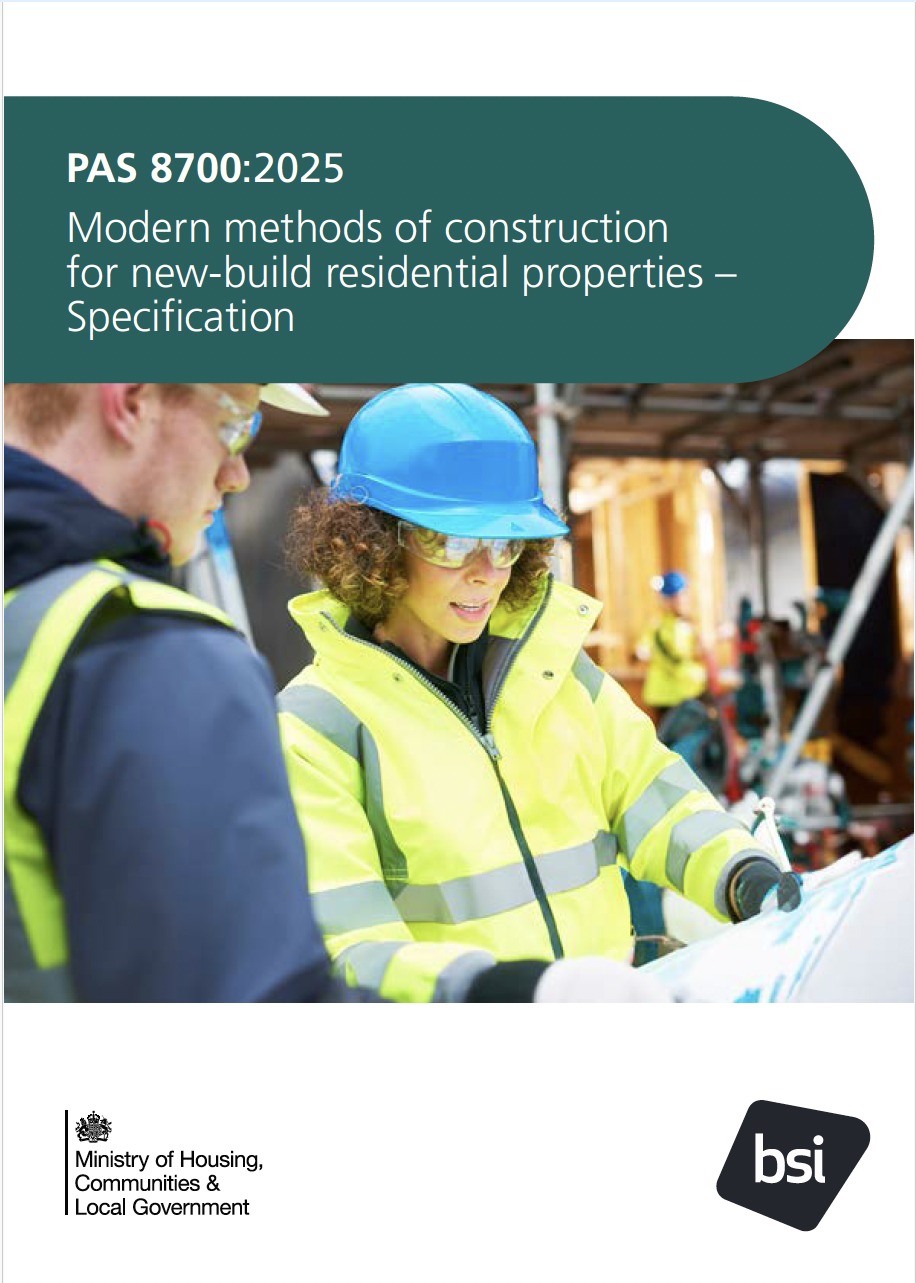
Published on 30 April 2025, PAS 8700:2025 Modern methods of construction for new-build residential properties – Specification sets out the process for the effective deployment of modern methods of construction (MMC) in residential development to improve stakeholder understanding and realise the benefits of MMC. As the sector has significantly evolved and matured, there is a need for greater consistency and comparability to increase the use of MMC.

This PAS has therefore been developed to provide a unified specification, which is material and technology agnostic, and to act as a coordinating document that directs readers to other technical requirements. The aim is to support the procurement, design, manufacture, construction and use of safe, resilient and repairable residential buildings that use MMC.

As BSI explains: “PAS 8700:2025 is the first standard specifically designed to define the effective use of Design for Manufacture and Assembly (DfMA) and MMC in residential building projects, encompassing both entire building systems and individual elements.

It provides provisions for the sector on the consistent application of MMC throughout all project phases—from design and manufacturing to assembly, maintenance, adaptation, and end-of-life considerations.

The standard aligns with existing technical regulations and accreditation schemes, avoiding duplication and unifying fragmented practices into a clear, accessible specification.”

BSI believes that effective deployment of MMC can bring multiple benefits to building projects, including “cost and timescale certainty, improved productivity, material efficiency, reduced labour, and overcoming skills shortages”. It could also enable better quality control, faster delivery, sustainable use of materials, and more.

You can find out more and download the document here.

Ryan hits the top…

Many of you will know Ryan Hodgson, one of Housing H&S Compliance UK Ltd’s valued associates and a co-founder of The Social Housing Safety Network Scotland; you may have even worked with him or attended one of his training sessions.

Well, we are absolutely delighted to let you know that Ryan has been quietly working hard in the background on a qualification to further develop his skills, knowledge and experience and he has been awarded the Level 7 NVQ Diploma in Strategic Health and Safety Leadership and Management.

We would like to give you a bit of an insight into Ryan's career and what studying and completing the qualification has added to Ryan's already impressive skillset, as well as what passing this qualification means to him.

Ryan has a wealth of knowledge and experience, particularly in the social housing sector, which he joined in 2007; prior to that he trained to be an accountant (yes.. we know!!) and then moved into the construction sector, where his passion lay. Ryan, like most of the Housing H&S Compliance UK Ltd associate team, has gained his knowledge and experience by working ‘hands on’ in the sector and has certainly found his ‘niche’. Over some 18 years in the sector he has moved from trades operative to trades manager and then moved into asset management, which included all of the tenant and resident safety elements of compliance.

Ryan already has numerous compliance related qualifications across the ‘big 6+’ and felt that he was ready to commit to a more strategic qualification and gain recognition of all of his skills, knowledge and experience; the Level 7 NVQ Diploma for Strategic Health and Safety Leadership and Management fitted the bill and Ryan felt this would galvanise his commitment and future career path.

The individual elements of this Level 7 qualification also reflect the work that Ryan is currently involved in, including;

  • his development as a strategic manager
  • digital technologies and incident investigation
  • establishing business risk management processes
  • risk-based safety systems management
  • safety culture, sustainability and the global effect on performance.

Naturally, we’re all delighted for Ryan in his fantastic achievement, so we asked him about the qualification and what this means to him; he said:

“I am over the moon that I have finally completed and achieved this diploma, it is one of the biggest qualifications in terms of research, work and submissions that I have completed in recent years, but I have learned so much throughout the process. It meant committing a huge amount of time over the last 12 months or so, alongside my other commitments, including family and a ‘more than’ full time job .. so, whilst it was exceptionally hard work, I’m just delighted to have all of the hard work and dedication pay off by successfully completing the qualification”

“This qualification was selected, not just to better myself, but to further my understanding and knowledge around strategic health and safety leadership and management and how this is a huge factor for all organisations across our sector. What’s also great is the recognition that comes with completing a higher qualification from the industry and the institutes I am a part of who will also acknowledge my commitment to CPD.”

Managing director of Housing H&S Compliance UK Ltd and fellow co-founder of The Social Housing Safety Network Scotland commented; "I’m absolutely delighted for Ryan and know the amount of work that he has put in to achieving the qualification, on top of the excellent, valuable work he has been completing alongside our valuable clients and members. I’ve known Ryan for many years, and his knowledge of the sector and tenant and resident safety is top class;  I really can’t express how delighted I am that he is part of our team. We’ve still got lots to achieve and some exciting new projects in the pipeline that Ryan will be an integral part of - this qualification really does take his knowledge to another level."

Congratulations Ryan, we’re all really proud of your achievement.

Scottish Housing Regulator (SHR) publishes outcome of its annual risk assessment of social landlords

On 31st March 2025 the SHR published updated engagement plans for all registered social landlords (RSLs) and local authorities as well as a summary report which shows that the majority of RSLs comply with the Regulatory Standards.

The summary report also sets out the main risks and strategic challenges facing social landlords and tenants including underlining the importance of landlords meeting the Scottish Housing Quality Standard and statutory requirements on tenant and resident safety.

In this briefing note collated for The Social Housing Safety Network Scotland, we highlight the key outcomes relating to tenant and resident safety, although you can read the full publication here.

Falls and their impact on social housing

Falls are the biggest cause of accidental injury in the home, resulting in a staggering 80% of hospital admissions for accidental injury to people aged 65 and over in the UK. Community-based studies suggest that one in three over-65s, and half of over-80s, will experience at least one fall every year.

RoSPA estimates 212,000 falls are suffered by older adults in England’s housing association households every year. This is thought to be a very conservative figure based on single occupancy households and without consideration of the disproportionate impacts of deprivation and poor health outcomes felt by social renters.

Falls impose an immeasurable burden on society through physical and psychological harm. Between 5 and 20% of falls cause serious injuries - for example hip fractures or traumatic brain injuries. These often require expedited property adjustment, adaptation or relocation, placing a strain on housing services that is difficult to forecast and plan for.

Injuries, dampened confidence and lost independence can lead to property neglect and reliance on care and social support - all of which damage community adhesion. Some falls might trigger a negative spiral, leading to increased vulnerability, safeguarding issues, and further complexity to interactions between renter and their social landlord.

Based on a hugely successful pilot at Staffordshire-based housing association Trent & Dove, RoSPA has developed a toolkit aimed at reducing the impact of tenant falls in social housing. The model combines staff training, home safety checks and effective partnership working to address fall risks and facilitate a measurable reduction in number of falls suffered by participants.

The 3-component toolkit contains novel materials developed specifically for the social housing sector. It includes practical ideas to support tenants reduce their falls risk and home safety check sheets to ensure tenants are given consistent and reliable advice.

You can read more and download the toolkit here.